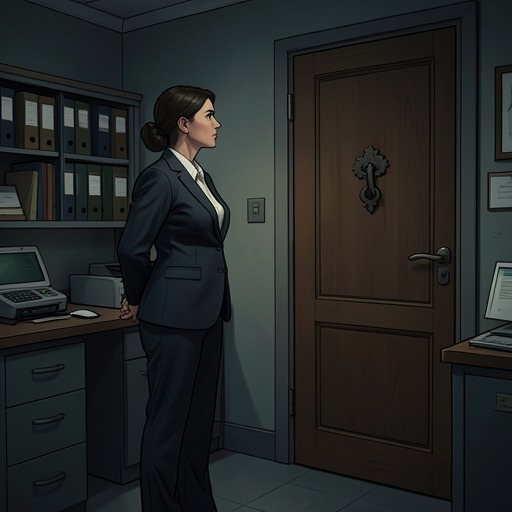
Myriam's Return to Legal Practice
Chanson douceMyriam’s return to legal practice is a hard-won re-entry into a professional life she feared she had lost, and a turning point that reorganizes the Massé household around paid work and hired care. What begins with the chance appearance of Pascal, a former law-school classmate, gives Myriam back a sense of possibility; what follows makes clear that this return depends not only on her ability and determination, but also on a difficult family negotiation and Louise’s expanding labor in the home.
From isolation to an opening
For months, Myriam had concealed how ashamed and diminished she felt at home. She had stopped accepting dinner invitations and answering friends’ calls, and dreaded strangers asking what she did for a living. Her world seemed narrowed to the children’s antics and overheard conversations among shoppers. During this period she began stealing small items at the Monoprix on Boulevard Saint-Denis—first children’s socks accidentally left in the stroller, then, on later visits, shampoo, cream, or lipstick. The petty thefts gave her a private, brief thrill, but they did not change the confinement she felt.
The opening arrives by chance at a carousel, where Myriam meets Pascal, her former classmate from law school. He does not recognize her at first: she wears oversized trousers and worn boots, and her hair is dirty and pinned up. Mila refuses to leave the ride, while Myriam tries to manage her and searches her pockets and bag for a sweet to quiet her. Pascal talks about the law firm he has established with two classmates; Myriam listens intently, acutely aware of her appearance and of the children interrupting. He barely notices the children, does not ask their names, and leaves after walking with her toward a nearby appointment.
After he goes into a building, Myriam is overwhelmed by the fear that he has judged her and will tell their old classmates that she has failed to make the career they expected. At home, the quiet happiness of caring for Mila and bathing the baby seems insufficient to console her. That night, imagined conversations keep her awake. The next morning Pascal texts to ask whether she has considered returning to law and offers to discuss it. Myriam leaps around the apartment with joy and kisses Mila, who asks why her mother is laughing. The sudden offer turns the chance encounter into a concrete possibility, though Myriam cannot know whether Pascal has recognized her distress or simply remembered her as one of the most serious students he knew.
The household’s negotiation
Myriam tells Paul about the offer and is hurt when he responds that he had not known she wanted to work. Their discussion quickly becomes angry: she calls him selfish, while he calls her behavior irresponsible and asks what they will do with the children. His mockery of her ambitions intensifies her feeling of being trapped in the apartment. Their argument is not simply about whether she may work; it is about who will absorb the care that makes work possible.
Once they have calmed down, they examine the available options. It is late January, too late to expect a place in a crèche or nursery, and they have no useful contacts at the mairie. Their income would leave them in an especially difficult bracket: too well-off to obtain emergency assistance, yet too poor to hire a nanny without sacrifice. They choose to hire one. Paul calculates that, after overtime, Myriam’s earnings will roughly match the nanny’s wages, but qualifies his support by saying that it is worth doing if the work will fulfill her. Myriam carries away bitterness and resentment. The arrangement makes her return financially possible, but its cost is framed in a way that leaves her ambition appearing almost to justify itself through its capacity to pay for its own replacement care.
Louise makes the return possible
Myriam seeks a nanny through a neighborhood agency, but the decisive choice comes when Louise arrives for an interview. Myriam later remembers it as an immediate certainty, almost a romantic coup de foudre, and emphasizes that Mila chose Louise. The child has just woken from a nap, disturbed by Adam’s cries, and hides between Paul’s legs. Louise takes Adam gently from him and pretends not to see Mila, instead beginning a game about a missing princess. Mila laughs, and Louise searches under the table and behind the sofa. The playful ease of the encounter persuades Myriam that Louise can reach her daughter.
Louise presents herself as available, says that her husband is dead and that her daughter Stéphanie is nearly twenty, and supplies references from former employers. One reference, the Rouvier family, confirms that Louise had been with them for a long time and cared for their two boys. When Myriam and Paul call, the former employer praises Louise as a second mother to her sons and says parting with her had been heartbreaking; she had even considered having a third child to keep Louise. The recommendation gives the Massés a picture of care that can become indispensable to a family.
On Louise’s first day, Myriam explains the appliances and gives detailed instructions. She repeatedly points out possessions and clothing she values, and warns that Paul’s vinyl collection is off-limits to the children. Louise listens quietly, observing the rooms with the composure of a commander surveying territory. In the weeks that follow, she transforms the disorderly apartment into a meticulously maintained bourgeois interior. She sews buttons onto jackets, hems skirts and trousers, mends Mila’s clothes that Myriam had been ready to discard, washes curtains yellowed by tobacco and dust, and changes the sheets weekly. Paul jokes that she resembles Mary Poppins; Louise may not understand the compliment. The fresh sheets and repaired clothes make the couple feel improbably fortunate, and Paul no longer complains that her wages strain the budget. Within weeks, her presence has become indispensable.
Louise’s work extends beyond tidying. Myriam comes home to dinner already prepared and children who are calm and combed. Louise teaches Mila to put things away, and the child begins hanging her own coat on its hook, astonishing her parents. When Myriam returns late after work, Louise continues cleaning the bath, preparing the children’s beds, doing laundry, and starting dinner even as Myriam insists she will take over. Louise gently pushes her away and tells her to rest and enjoy the children. Myriam yields more tasks each day. The arrangement that permits her to resume law therefore also transfers a widening share of domestic care to Louise, whose work makes the family’s functioning appear effortless.
Professional re-entry and its demands
On the morning Myriam returns to work, she wakes before dawn with childlike excitement, puts on a new skirt and heels, and receives Louise’s assurance that she looks beautiful. Holding Adam, Louise ushers her out and tells her not to worry: everything will be all right at home. The scene marks the practical threshold of Myriam’s return. Her departure is made possible by another woman’s confidence and presence, even as the household remains the condition she has to leave behind in order to reclaim her profession.
Pascal welcomes Myriam warmly and gives her an office connected to his by a door they often leave open. Within two or three weeks he entrusts her with responsibilities that older associates have never received. Over the following months she handles cases for dozens of clients on her own. She accepts every file Pascal gives her, never refuses work, and does not complain about finishing late. Her caseload is made up largely of small, difficult matters: she represents minor dealers, people described as foolish, an exhibitionist, inept robbers, and drunk drivers, and handles cases involving debt, credit-card fraud, and identity theft. Pascal encourages her to build experience and deploy the formidable work ethic he knows she has; his repeated praise that she is perfect accompanies a workload that keeps expanding.
The work also takes Myriam beyond the office. Pascal counts on her to bring in new clients and encourages her to spend time on legal aid. Twice a month she goes to Bobigny courthouse, where she waits in the corridor until as late as nine at night, watching the minutes crawl by. She can become abrupt with disoriented clients, but she tries to do what she can for them. Pascal insists that she must know every file by heart, and she responds by rereading police reports late into the night, searching for the smallest procedural error or imprecision. Her meticulousness and intensity bring results: former clients recommend her to friends, and her name circulates among detainees. Her return is thus not a symbolic restoration alone; it develops into a demanding practice built on preparation, persistence, and a growing reputation.
Dependence, care, and the cost of return
The new division of labor creates an intimate dependence that neither salary nor the language of choice fully captures. Myriam’s professional concentration is real: she reaches the office before eight, switches on only the small lamp on her desk, and finds again the focused silence of her student years. She studies files with pleasure, walks through the dark corridor holding documents and talking to herself, and smokes a cigarette with coffee on the balcony. This early solitude contrasts with the crowded domestic life from which the return has released her, and with the long days and late nights the work now demands.
At home, Louise becomes increasingly invisible precisely as she becomes more necessary. Myriam no longer calls to warn her when she will be late, and Mila stops asking when her mother will come home. Louise arrives earlier and leaves later, quietly holding together the household while Myriam accepts being cared for. The return to law therefore has no clean boundary between public achievement and private relief: Myriam’s regained professional identity rests on care performed by someone whose own effort fades into the background.
That imbalance also shadows the children’s experience. Louise’s playful care can turn into a form of control: she hides from Mila and Adam without announcing rules, watching them panic and cry while she remains concealed; later, after Mila has wandered away, she holds the child so tightly that Mila says she cannot breathe, then warns her that someone might steal her and that no one would come when she cried. The return-to-work arrangement is not the cause of these acts, but it places the children in Louise’s care for long stretches and makes the difference between necessary dependence and possessive control consequential. The practical solution that gives Myriam a way back to work also creates an intensely private world of childcare beyond her sight.
Myriam’s return is a genuine recovery of professional purpose, not a simple escape from motherhood or a frictionless resolution of its demands. Pascal’s message reopens a future she had begun to fear was lost; the argument with Paul reveals how little the household had prepared to share care; and hiring Louise enables Myriam to resume the law while making Louise indispensable. In the office, Myriam’s skill and labor become visible through responsibility, difficult cases, and recommendations. At home, the labor supporting that achievement remains largely unseen. The contrast gives her return its decisive significance: professional independence is regained, but under domestic conditions that bind the family to the woman hired to make it possible.